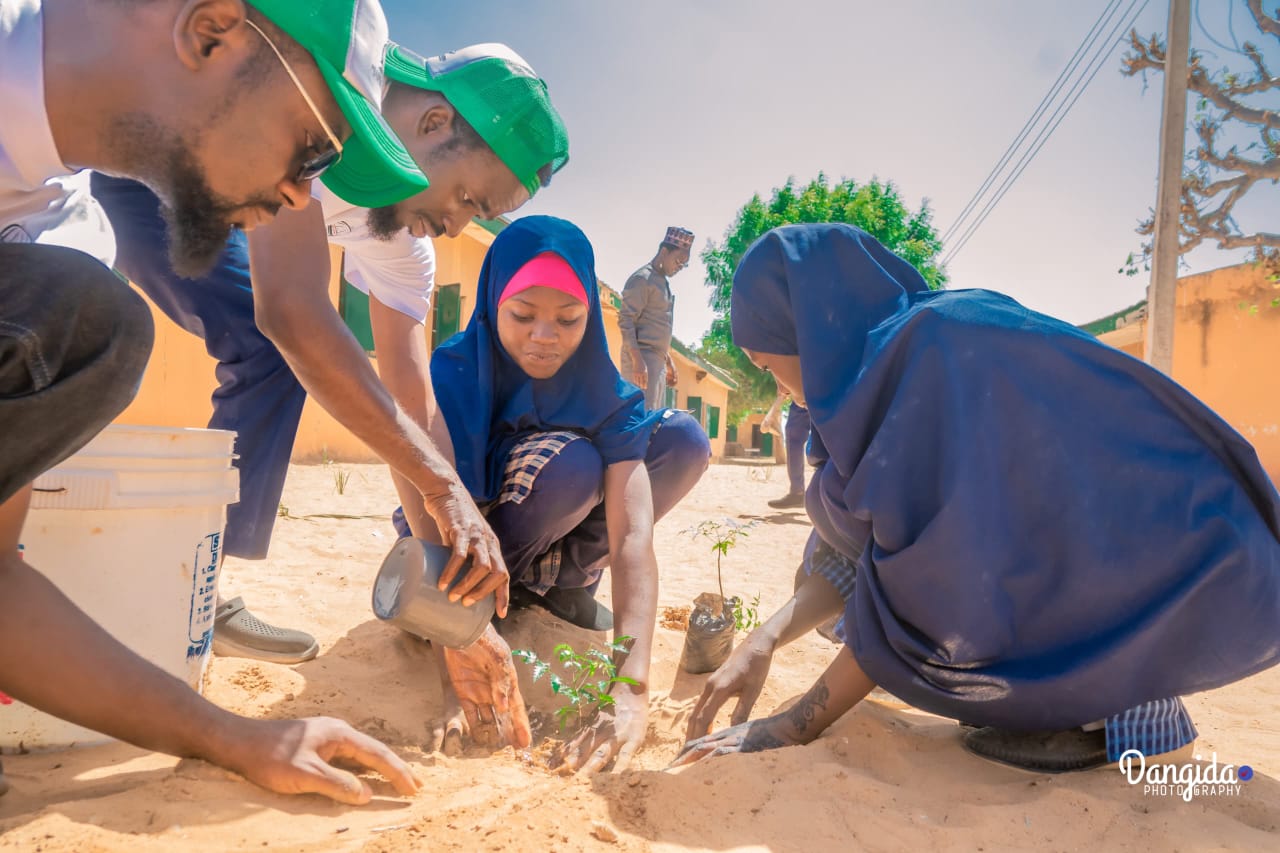
The midday sun over Northern Nigeria can be unforgiving. Across Kano, Jigawa, and Bauchi, where dry seasons grow longer and desertification edges south, the rising heat is an immediate threat to everyday life. In classrooms, students struggle to focus in sweltering rooms. In rural clinics, patients wait under bare courtyards with no refuge from the heat. While climate policies are routinely debated in high-level assemblies, local communities on the front lines are still facing degraded lands and shrinking green spaces.
Refusing to let climate action remain a theoretical concept, the Alumni Association of the Legislative Mentorship Initiative (AALMI), through its Committee on Finance, Treasury and Fundraising set out to translate policy into practical relief. Their focus was straightforward: demonstrate that legislative leadership means stepping into communities, digging into the soil, and delivering tangible environmental stewardship.
In Bauchi State, the project demonstrated how young leaders can bring government agencies together around a shared goal. Partnering with the Bauchi State House of Assembly, the Bauchi State Environmental Protection Agency (BASEPA), the Ministry of Education, and BCCFSDI, the flag-off at UBEC Smart School kicked off planting operations across six additional public sites across the state.
The effort continued in Kano State at Bayero University, Kano (BUK), where alumni, university administrators, and students gathered to set down the first rows of saplings. The momentum carried forward into essential public institutions, extending green to the Aminu Kano Teaching Hospital and the Maryam Abacha American University of Nigeria, bringing relief to spaces dedicated to healthcare and learning.
In Jigawa State, the focus turned toward younger generations. Flagged off at Dutse Capital School, the campaign brought students alongside healthcare workers to plant trees across seven secondary schools and a primary healthcare facility. For these staff and students, the saplings were more than an environmental metric; they represented future shade, cooler schoolyards, and better working conditions for health personnel.
By the conclusion of the campaign, over 1,300 trees were planted across the three states. Recognizing that planting is only the first step, AALMI established local custodianship frameworks to ensure long-term survival. The daily care, watering, and monitoring of the saplings were handed over to student environmental clubs, school administrators, and facility managers in every location.
By restoring local ecosystems, this grassroots campaign directly supports national environmental targets under the Great Green Wall Initiative and Nigeria’s Nationally Determined Contributions (NDCs) under the Paris Agreement. More than anything, it offers a practical model of public service: showing how young, policy-minded leaders can move out of conference rooms and directly into communities to build cooler, healthier, and more resilient environments.